

- House prices have outpaced wages: Over the past 50 years, average property prices jumped 3,306% while salaries grew by just 1,031%.
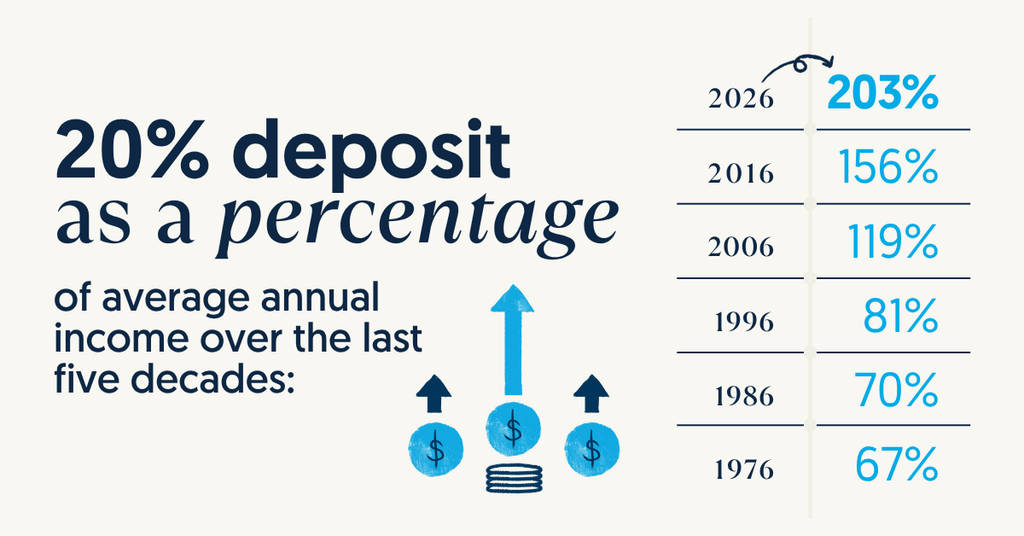
- Deposits take double an annual income: Saving a 20% deposit in 2026 requires $220,080—equivalent to 203% of the average salary, compared to 67% in 1976.
- Young buyers feel locked out: Nearly 30% of 18–34-year-olds feel it is almost impossible to enter the property market.
- Government schemes lower the barrier: State incentives and the federal 5% deposit scheme reduce the upfront target to $55,020 (50.8% of the average salary).
With house prices increasing exponentially and wages not keeping up, almost 30% of 18-34-year-olds say it feels borderline impossible to get into the property market, according to a Loan Market survey.
Let’s take a look back over the last five decades to see how houses, salaries, and deposits have changed, and if the younger generations really do have it the hardest.
How house prices and deposits have changed
A lot has changed over the last five decades, with wage growth lagging behind rapidly growing house prices.
1976:
Average capital city house price: $32,307
Average full-time salary: $9,584
Value-to-income ratio: 3.4
Average 20% deposit amount: $6,461
Percentage of income: 67%
1986:
Average capital city house price: $76,278
Average full-time salary: $21,783
Value-to-income ratio: 3.5
Average 20% deposit amount: $15,256
Percentage of income: 70%
1996:
Average capital city house price: $143,922
Average full-time salary: $35,698
Value-to-income ratio: 4
Average 20% deposit amount: $28,784
Percentage of income: 81%
2006:
Average capital city house price: $327,594
Average full-time salary: $55,063
Value-to-income ratio: 6
Average 20% deposit amount: $65,519
Percentage of income: 119%
2016:
Average capital city house price: $623,000
Average full-time salary: $79,721
Value-to-income ratio: 7.8
Average 20% deposit amount: $124,600
Percentage of income: 156%
2026
Average capital city house price: $1,100,400
Average full-time salary: $108,378
Value-to-income ratio: 10.2
Average 20% deposit amount: $220,080
Percentage of income: 203%
How young buyers can get into the market
Over the last 50 years, wages have increased by 1,030.82%, whereas property prices have increased by an astronomical 3,306.07%.
The loan-to-income ratio has more than tripled in the last 50 years and deposits have grown to more than 200% of the average annual income.
Luckily for many first-home buyers, the federal government’s 5% deposit scheme allows buyers to get into the property market with a much smaller deposit.
In 2026, a 5% deposit on the average home is $55,020, which is just 50.8% of the average salary, making it a much more achievable goal for first-time buyers.
Each state also has their own first-home buyer schemes available to help young people enter the property market.
A Loan Market broker can help you navigate your options and help find the right loan for you.
To have your say on the generational housing divide, complete our survey for Loan Market’s Intergenerational Report.