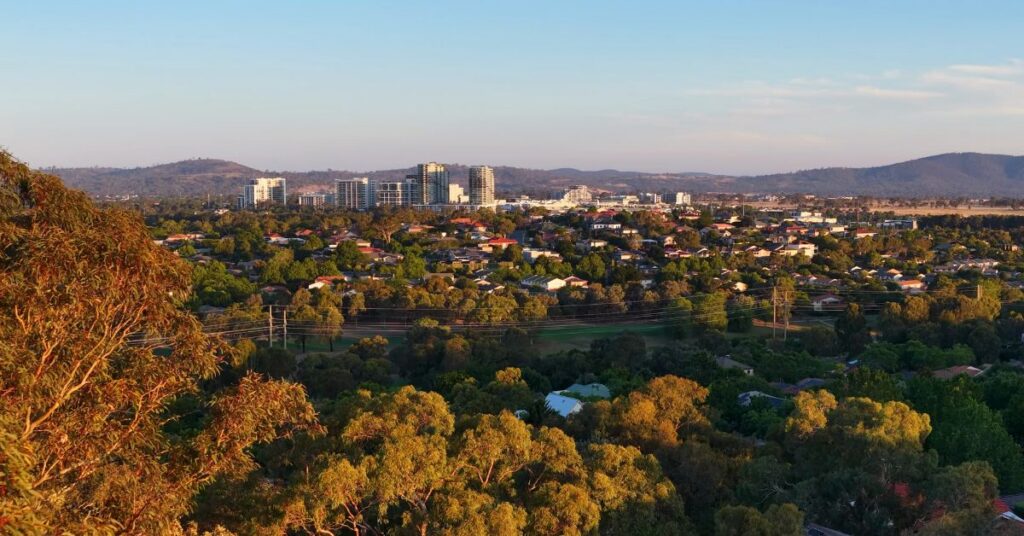

- Canberra’s overall growth has been modest lately, but a cluster of outer suburbs has quietly outperformed the rest of the city over the past decade
- The strongest gains are concentrated in three growth corridors, Gungahlin, Molonglo Valley and Belconnen’s northern fringe, rather than spread evenly across the city
- Entry prices in these suburbs sit well below Canberra’s overall median, which matters if you’re comparing best Canberra suburbs for long-term capital growth against affordability.
Picture two friends comparing notes over coffee. One bought in Forrest a decade ago and has watched the value climb past $3 million. The other is starting out now, with a fraction of that budget, and Forrest simply isn’t on the table.
That second scenario is far more common. Most people searching for Canberra property hotspots right now aren’t chasing trophy homes in the inner south. They’re after suburbs where the entry price is realistic and the growth story is still unfolding, which is exactly where Canberra’s outer corridors come in. Suburbs there have recorded some of the strongest growth rates in Canberra over the past decade, and they remain within reach for a first-time investor or a rentvester weighing up their next move. Whether that move stacks up could potentially depend on your circumstances, including your borrowing capacity and the lender you go with.
Where should I buy an investment property in Canberra right now?
Right now, the strongest case sits in three corridors: Gungahlin, Molonglo Valley and the northern fringe of Belconnen. These areas combine below-median entry prices with the highest 10-year house price growth rates recorded across Canberra.
Gungahlin has been Canberra’s standout performer for a while now, driven by new housing supply and steady population growth as the district has built out. Molonglo Valley is younger again, still filling in with new estates, which is part of why its growth curve has been so sharp. Belconnen’s fringe suburbs sit in between, benefiting from established infrastructure without the price tag of the inner suburbs nearby. None of this guarantees future performance. Past growth is simply the clearest signal available, and it’s the one this article works from.
How does Canberra’s growth compare to other Australian capitals?
According to Loan Market’s Property Insights Report, Canberra’s annual house price growth of 2.3% is one of the softer results among the capital cities, well behind Darwin and Perth. Unit prices have grown even more modestly, up 1.9% over the same period. The table and figures below set Canberra against the other capitals for context on where the Canberra property hotspots covered later in this article sit relative to the wider market.
Canberra’s median house price currently sits at $1.01 million, up 2.3% over the past year and 72.3% over the past decade. Unit prices tell a similarly modest story, with a median of $630,000, up 1.9% annually and 51.6% over ten years, a slower pace than the house market’s decade-long run. Rental figures echo this pattern. Canberra’s median weekly house rent sits at $730, up 2.8% annually, while unit rent sits at $590, up 3.5% annually, both trailing the rental growth recorded in several other capitals.
This matters for how you read the suburb data below. A city-wide figure of 2.3% hides a lot of variation underneath it, and the 10 suburbs in this list have grown at multiples of that rate over the past decade. Here’s how Canberra’s headline numbers stack up against the other capitals, according to Ray White Now.
| City | Median house price | 1-year growth |
|---|---|---|
| Darwin | $760,000 | 16.2% |
| Perth | $1.02 million | 14.3% |
| Brisbane | $1.15 million | 10.5% |
| Adelaide | $970,000 | 9.5% |
| Canberra | $1.01 million | 2.3% |
| Sydney | $1.68 million | 0.0% |
| Melbourne | $950,000 | -1.2% |
Source: Ray White Now, July 2026, and Loan Market’s Property Insights Report for Canberra-specific figures.
The top 10 Canberra suburb hotspots
Canberra’s 10 strongest performing suburbs over the past decade sit across three corridors: Gungahlin, Molonglo Valley, and Belconnen’s northern fringe. Together they represent some of the best Canberra suburbs for long-term capital growth currently on the market.
Six of the 10 suburbs sit in Gungahlin alone, reflecting the corridor’s decade of steady new supply and population growth, while Molonglo Valley and Belconnen’s fringe each contribute two. Recent sales activity backs this up. Canberra’s house sales over the past twelve months concentrated heavily in the $750,000 to $1.5 million bracket, which lines up closely with where most of these ten suburbs currently sit. The sections below break down each corridor in turn.
The Gungahlin growth corridor
Gungahlin has produced six of Canberra’s ten strongest performers: Taylor, Moncrieff, Throsby, Crace, Ngunnawal and Casey. This is where the question, ‘where should I buy an investment property in Canberra right now?’ has one of its clearest answers, thanks to consistent new supply and steady demand.
Taylor leads the entire city at 167.6% growth over ten years, followed closely by Moncrieff at 149.7%. Throsby, Crace, Ngunnawal and Casey round out the corridor, each posting growth above 87% over the same period. Prices across these six suburbs range from about $820,000 in Ngunnawal to around $1.11 million in Crace, which puts most of the corridor within reach of a typical Canberra buyer. Rental yields across the corridor are strongest in Ngunnawal, where houses sit at 4.25%.
The Molonglo Valley corridor
Coombs and Wright anchor Canberra’s newest growth corridor, Molonglo Valley, west of the city centre. Both suburbs are still filling in with new housing stock, which helps explain their strong recent trajectory.
Coombs has grown 97.0% over the past decade to a current median of $1.19 million. Wright has grown 85.1% to $1.25 million. It’s a smaller corridor than Gungahlin. Two suburbs, not six. But the growth rate per suburb has held up well against the wider field, reflecting the corridor’s rapid build-out over the past decade. Coombs also carries the stronger house yield of the two, at 4.07%.
Belconnen’s northern fringe
Macgregor and Charnwood round out the list, sitting on Belconnen’s northern edge. These two are a little different again: established suburbs rather than new estates, benefiting from proximity to Belconnen’s town centre without carrying its price premium.
Macgregor has grown 85.2% over ten years to $830,000, while Charnwood has grown 88.7% to $770,000, making it one of the more affordable entries on this list. Both suburbs sit well under Canberra’s overall median house price, which is worth noting if where to buy affordable property in Canberra with high yields is the question driving your search. Charnwood also edges out Macgregor on yield, with houses returning 4.63%.
Ranked suburb table
| Rank | Suburb | Corridor | 10-year growth |
|---|---|---|---|
| 1 | Taylor | Gungahlin | 167.6% |
| 2 | Moncrieff | Gungahlin | 149.7% |
| 3 | Throsby | Gungahlin | 114.0% |
| 4 | Coombs | Molonglo Valley | 97.0% |
| 5 | Crace | Gungahlin | 91.3% |
| 6 | Ngunnawal | Gungahlin | 89.3% |
| 7 | Charnwood | Belconnen fringe | 88.7% |
| 8 | Casey | Gungahlin | 87.3% |
| 9 | Macgregor | Belconnen fringe | 85.2% |
| 10 | Wright | Molonglo Valley | 85.1% |
Source: Loan Market’s Property Insights Report.
What Canberra mortgage brokers are seeing on the ground right now
Local Loan Market brokers are seeing steady interest in Canberra’s outer growth corridors, particularly from interstate investors who arrive already knowing which suburbs they want. That interest lines up with a sharp rise in new listings, which reached 776 properties in June, well above the same month last year. The quote below reflects what brokers are hearing directly from clients.
That kind of specificity is new. A few years ago, most enquiries were about Canberra generally. Now buyers arrive already knowing which corridor they want, which makes the conversation about finance, and what you may be able to borrow, a much faster one to have.
Your six-step roadmap to buying in one of Canberra’s hotspot suburbs
Buying in one of Canberra’s growth suburbs follows the same broad process as any property purchase, starting with your borrowing capacity and ending with settlement. The six steps below outline what to do in order, assuming you’ve already narrowed your search to one or two suburbs from the corridors above.
- Get a clear picture of your borrowing capacity. This could potentially depend on your circumstances, including your income, existing debts and deposit size.
- Shortlist two or three suburbs from the corridors above. Spreading your search across all ten will make your due diligence unmanageable, so narrow it down early.
- Request recent comparable sales for your shortlisted suburbs. Look at results from the past three to six months to sense-check the growth figures against current asking prices.
- Speak with a Loan Market broker about pre-approval. Any rate or approval is always subject to lender eligibility and individual circumstances.
- Factor in ongoing costs beyond the purchase price. This includes body corporate fees for units, land tax if applicable and Canberra’s rates structure.
- Move on finance once your pre-approval is confirmed. Settlement timeframes can shift depending on the suburb and the vendor, so build in some flexibility.
Common questions about Canberra’s suburb hotspots
The questions below cover the most common searches from buyers looking at Canberra’s growth suburbs, from where to buy right now through to deposit requirements. Each answer draws on the suburb and pricing data covered earlier in this article.
What are the next boom suburbs in Canberra?
Based on the strongest 10-year growth data available, Taylor, Moncrieff, and Throsby in Gungahlin have shown the clearest upward trajectory. Coombs and Wright in Molonglo Valley aren’t far behind. None of this is a guarantee of future performance, since past growth reflects what has already happened rather than what comes next.
Where can I buy affordable property in Canberra with high yields?
Charnwood and Macgregor currently sit among the more affordable options on this list, with median house prices under $850,000. Exact yield figures for these suburbs are still being confirmed, so treat the affordability angle as the stronger signal for now.
Which Canberra suburbs offer the best long-term capital growth?
Taylor and Moncrieff have delivered the strongest growth over the past decade, at 167.6% and 149.7% respectively. Both sit in the Gungahlin corridor, which has consistently outperformed the rest of Canberra over that timeframe.
Do I need a large deposit to buy in a Canberra growth suburb?
Deposit requirements vary by lender and by your individual financial position, so there’s no single figure that applies to everyone. A Loan Market broker can walk you through what may be able to work for your situation, including options for a smaller deposit subject to lender eligibility.
Getting started in one of Canberra’s growth suburbs
This year’s Canberra property hotspots sit well outside the suburbs that usually make headlines, clustered instead across three outer corridors. To wrap things up, Gungahlin, Molonglo Valley and Belconnen’s northern fringe have all outpaced the wider Canberra market over the past decade, and they remain some of the more accessible entry points into the city. Whether one of these suburbs suits your budget and goals depends on your circumstances, and a conversation with a Loan Market Canberra broker is the fastest way to find out.
Speak to a Canberra broker today about your own situation.